
PREVIOUS
Blog
Three Functional Filler Families and How to Choose Where to Start
A practical guide to choosing between 3M™ Glass Bubbles, 3M™ Ceramic Microspheres and Kenospheres®.
Explore three functional filler families and use the application objective, process constraints and grade evidence to choose a useful starting point.
3M™ Glass Bubbles combine low density with a hollow spherical structure that can help manage viscosity, reduce shrinkage and lower thermal conductivity, depending on the grade and formulation. Solid 3M™ Ceramic Microspheres can support efficient particle packing, lower resin demand and improved scrub and burnish resistance in coatings. Kenospheres® provide a lightweight hollow ceramic option for applications where flow, thermal insulation and resistance to elevated temperatures are important.
Across all three families, grade selection should reflect the formulation, processing conditions and intended performance.
Table of Contents:
Related Technical Articles
The Technology Behind Anti-Condensation Paints (Part 1)
Three Functional Filler Families and How to Choose Where to Start
The Technology Behind Anti-Condensation Paints (Part 1)
Start with the Formulation Objective
A useful filler shortlist starts with the property you want to change and the conditions you need to preserve. This guide explains how three material families can lead to different evaluation paths, even when they appear in the same product portfolio.
These are starting directions for evaluation. The useful choice depends on the application, the manufacturing process and the combination of properties the finished product must achieve.
Begin by writing one clear objective, such as reducing the weight of a wall filler or improving a coating’s resistance to repeated cleaning. Then list the properties that must remain acceptable: application behaviour, appearance, adhesion or another requirement specific to the product. This separates the desired change from the constraints that could make an otherwise promising candidate unsuitable.
These three functional filler families are part of our wider portfolio. This guide focuses on their selection roles rather than covering the full range.
Understand the Role of Each Family
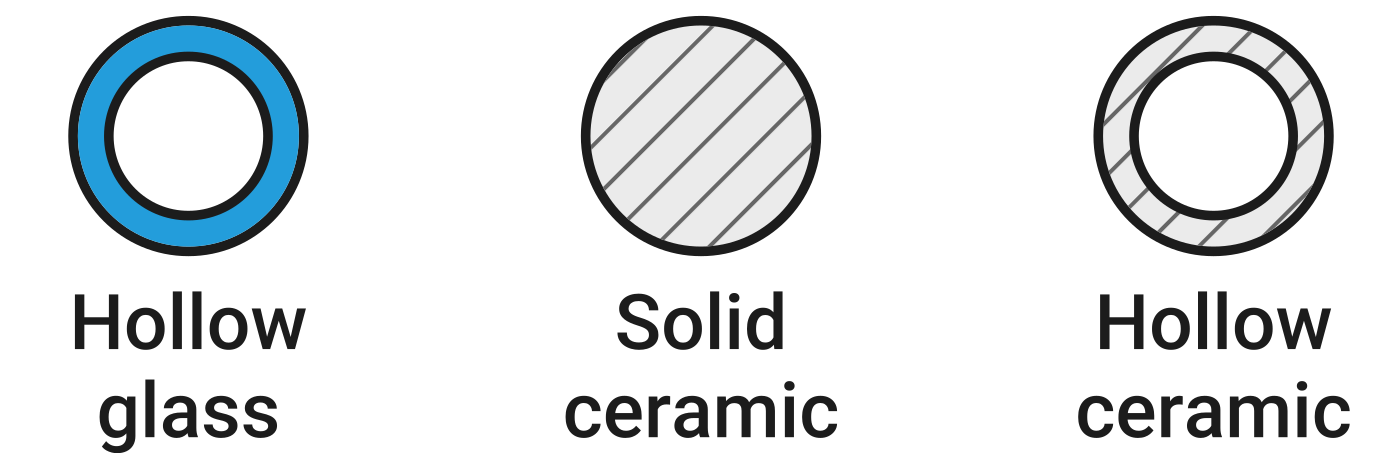
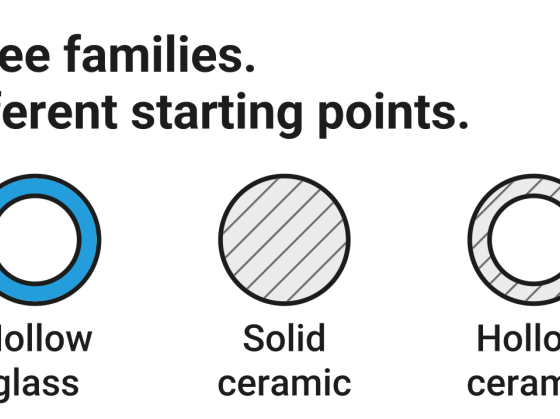
Conceptual schematic of hollow glass, solid ceramic and hollow ceramic particle concepts.
3M™ Glass Bubbles
3M™ Glass Bubbles are hollow soda-lime-borosilicate glass microspheres that can help reduce weight, manage viscosity, limit shrinkage and lower thermal conductivity in paints and coatings. Their contribution depends on the selected grade, the formulation and the processing conditions. Grade selection brings density, crush strength and particle size together.
A lower-density grade may support weight reduction, while particle size influences the intended surface finish and crush strength helps assess compatibility with processing conditions. The right choice balances these characteristics with the coating’s application and finished-film requirements.
The 3M™ Glass Bubbles in Paints and Construction brochure, available in the Sources section below, provides a selection guide comparing these characteristics. Use it to shortlist grades, then check the relevant grade documentation and evaluate the selected material in the intended formulation and process.
3M™ Ceramic Microspheres
3M™ Ceramic Microspheres are solid engineered particles made from alkali aluminosilicate ceramic that can support efficient particle packing, lower resin demand and improved scrub and burnish resistance in coatings. Their spherical shape, particle-size distribution and hardness make them useful tools for balancing formulation efficiency with surface performance.
The selected grade and loading should match the coating’s application and finished-film requirements. When reducing binder content, evaluate material savings alongside application properties, film integrity and surface durability. Scrub and burnish testing helps establish how the microspheres perform in the complete formulation.
The 3M™ Ceramic Microspheres Application Guide, available in the Sources section below, provides further information on these formulation considerations.
Kenospheres®
Kenospheres® are our hollow alumino-silicate ceramic microspheres, offering a lightweight filler option for formulations where density, flow, thermal insulation and resistance to elevated temperatures are important. Their contribution depends on the selected grade, the surrounding material and the processing conditions.
Grade selection brings particle size, density and processing requirements together. The relevant technical data sheet provides a starting point for comparing candidates, while formulation trials establish their effect on application properties and finished-product performance.
Kenospheres® complement the hollow glass and solid ceramic microsphere families, providing another route to matching particle structure and material characteristics to the needs of the application.
Turn the Objective into a Shortlist
The following situations are illustrative decision paths, not NANOVISION test results or customer case studies.
A Wall Filler Needs to Become Lighter
Start with the target finished-product density and the application requirements. 3M™ Glass Bubbles offer a lightweight hollow filler option, with grade selection guided by density, particle size and the crush strength needed for processing. Kenospheres® provide a hollow ceramic alternative to evaluate using the relevant grade data.
Weight reduction must work alongside spreadability, sanding behaviour and surface finish. Compare candidate formulations with the existing filler to establish which combination meets these requirements under the intended mixing and application conditions.
A Coating Brief Centres on Surface Performance
For coatings exposed to repeated cleaning or visible surface marking, 3M™ Ceramic Microspheres can help improve scrub and burnish resistance. Define the required durability and appearance, then select suitable grades and loading levels for evaluation. The 3M™ Ceramic Microspheres Application Guide, available in the Sources section below, provides supporting information.
Compare each candidate with the baseline coating under the same test conditions. Assess surface performance alongside application properties and film quality, keeping conclusions specific to the formulation, grade and loading tested.
Production Constraints Narrow the Options
Mixing, transfer and application conditions are part of material selection. Identify the equipment and incorporation sequence early, then check that the proposed grade is compatible with the complete production route.
The 3M™ Ceramic Microspheres Application Guide, available in the Sources section below, sets out different incorporation guidance for solid ceramic microspheres and hollow glass bubbles. Use the guidance for the selected material to plan trials, then verify dispersion and, for hollow particles, particle integrity under the actual processing conditions.
Choose the Evidence for the Next Decision
A productive material discussion should finish with a small, documented shortlist and a reason for each candidate. For every proposed grade, record:
- The application and property being targeted, together with the properties that must remain acceptable
- Exact family and grade, the document revision and the basis of the reported properties
- The manufacturing and application route, including any unresolved compatibility questions
- Baseline, acceptance criteria and measurements needed to judge the candidate fairly
- The documentation, sample or commercial information still required before the next step
This record also helps technical and procurement teams ask compatible questions. A price comparison needs a defined material and a clear basis. If the proposed benefit depends on changing the formulation, evaluate the cost implications of that change alongside the required performance. Do not count an anticipated saving as a demonstrated outcome.
Family-level literature is useful for orientation. Grade information helps choose candidates. Finally, evidence from the intended formulation and process supports the eventual application decision. Keeping those stages distinct makes it easier to see what is known and what still needs work.
Discuss your material-selection brief
Conclusion
The practical value of these three families lies in the different questions they help a formulator explore. Hollow glass bubbles offer a route to investigate density reduction. Solid ceramic microspheres provide a basis for examining packing, binder demand and coating surface performance. Kenospheres® bring a distinct hollow ceramic option that requires its own grade-specific assessment.
Choose where to start by defining the objective and constraints, then use the appropriate evidence to narrow the options. A well-framed material brief is more useful than a universal ranking of fillers.
Sources
1. 3M Glass Bubbles for Design and Construction. Opening description and “3M Glass Bubbles for paints and coatings”.
2. 3M Ceramic Microspheres. “3M Ceramic Microspheres for Paints and Coatings”.
3. 3M Ceramic Microspheres Application Guide. Rev. B, PDF pages 3-5 and 7.
4. 3M Glass Bubbles in Paints and Construction. PDF page 11, “Product portfolio”, and page 12, “Technical Information”.
5. NANOVISION Kenospheres product page. “Product Overview”, first paragraph. Our product overview is cited only for family identity and composition.
6. NANOVISION product portfolio. Our product listings.
You might also be interested in...

Increasing Time Until Condensation: Advanced Applications of 3M™ Glass Bubbles (Part 2)
You might also be interested in...

How can we help you?

24 Vasilissis Olgas Str. | 15124 | Athens | Greece
Phone: (+30) 213 0907763
Reg. Nr.: 181737601000
VAT. Nr.: 802731899
