
PREVIOUS
Blog
Ceramic Microspheres in Architectural Paint: Balancing Grade, Loading and Surface Properties
Balance appearance, cleaning resistance and surface feel with ceramic microspheres
Explore how grade and loading influence architectural paint performance, with a closer look at gloss, burnish, scrub resistance and hand feel.
A wall paint must do more than achieve the right gloss. It also needs to resist visible marking, withstand cleaning and provide the intended surface feel. Ceramic microspheres give formulators another way to balance these requirements, but grade and loading must be considered together: a combination that improves one property may leave another unchanged or make it worse.
Table of Contents:
Related Technical Articles
The Technology Behind Anti-Condensation Paints (Part 1)

3M™ Glass Bubbles and 3M™ Ceramic Microspheres in the EU Ecolabel Framework

Revolutionizing Paint and Coating Industry with 3M™ Glass Bubbles
Start with the Paint Formulation
A meaningful comparison begins with a defined paint, a reference formulation and a clear replacement basis.
Consider a flat architectural paint based on a 100% acrylic binder, Rhoplex VSR-50. In a laboratory comparison, W-210, W-410 and W-610 3M™ Ceramic Microspheres replaced equal total volumes of a mineral-filler blend containing Minex, Duramite and calcined kaolin clay (Iceberg). The paint without ceramic microspheres provided the reference. The mineral blend was maintained at stated Minex:Iceberg and Minex:Duramite volume ratios of 1.5 and 1.0, respectively.
The trial series used nominal ceramic loadings of 0, 2.5, 5 and 10 vol% of the final paint. The corresponding formulation entries were 0.00, 2.54, 5.08 and 10.16 vol%. These labels and quantities should remain distinct. They describe the tested formulations, rather than a production recipe or a recommended range for every paint.
Equal-volume replacement is central to understanding the results. The ceramic particles did not simply sit on top of an unchanged mineral-filler package: they replaced part of that package. The comparison therefore concerns the resulting complete paints, with the zero-ceramic formulation as the reference.
How Grade Changes the Surface
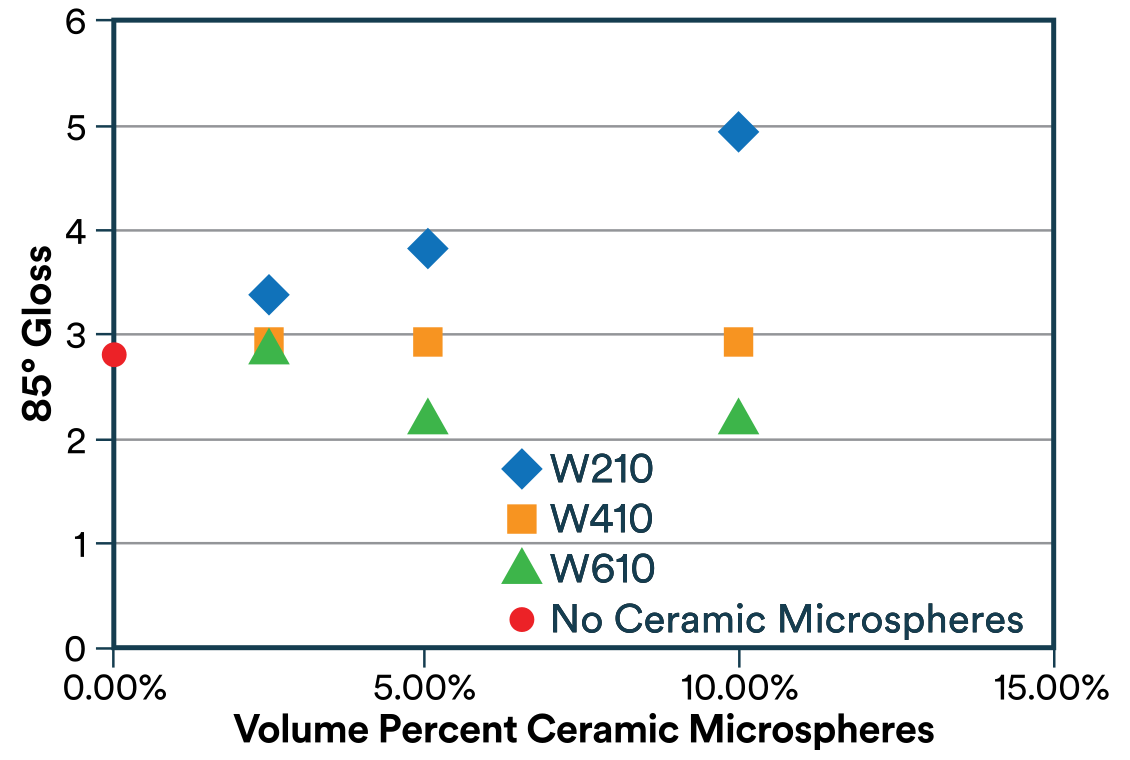
85-degree gloss against ceramic-microsphere volume loading for W-210, W-410 and W-610, including the no-ceramic control. Results apply to the tested acrylic-paint formulation and grades. Redrawn from 3M Ceramic Microspheres in Architectural Paint, p. 4.
The grades used in this comparison had different particle-size characteristics. Their listed effective top sizes were 12 µm for W-210, 24 µm for W-410 and 40 µm for W-610. These descriptive values identify the tested materials and are not for specification purposes.
Gloss
Gloss did not move in the same direction for every grade. In this acrylic paint, W-210 increased gloss, W-410 changed it little and W-610 reduced it. Ceramic microspheres therefore should not be treated as a single, interchangeable matting ingredient. The grade affects the balance between the intended finish and the other surface properties.
Particle size offers a useful way to understand the difference. In this formulation, the finer W-210 particles were associated with a smoother, glossier surface, while W-610 was associated with a rougher, less glossy finish. This explanation concerns the interaction between the ceramic particles and the mineral fillers they replaced; it does not establish that a particular particle size will give the same gloss in every coating.
Burnish
Burnish is the change in surface gloss after rubbing. It matters where contact can leave a visibly shinier mark on a low-gloss wall. All the ceramic-containing paints in this comparison showed less burnish than the paint without ceramic microspheres.
This result concerns appearance after rubbing. It is a different measure from the number of scrub passes a paint can withstand before failure. A formulation can resist visible gloss change without being the strongest performer in a separate abrasion test.
Scrub Resistance
Scrub resistance measures the number of abrasion passes a paint can withstand before failure. In this comparison, W-210 and W-410 reached their highest measured scrub resistance at the nominal 5 vol% loading, while W-610 showed increasing resistance across the tested loadings. At the lowest loading, W-210 and W-610 performed below the reference paint, demonstrating that adding ceramic microspheres does not automatically improve every property.
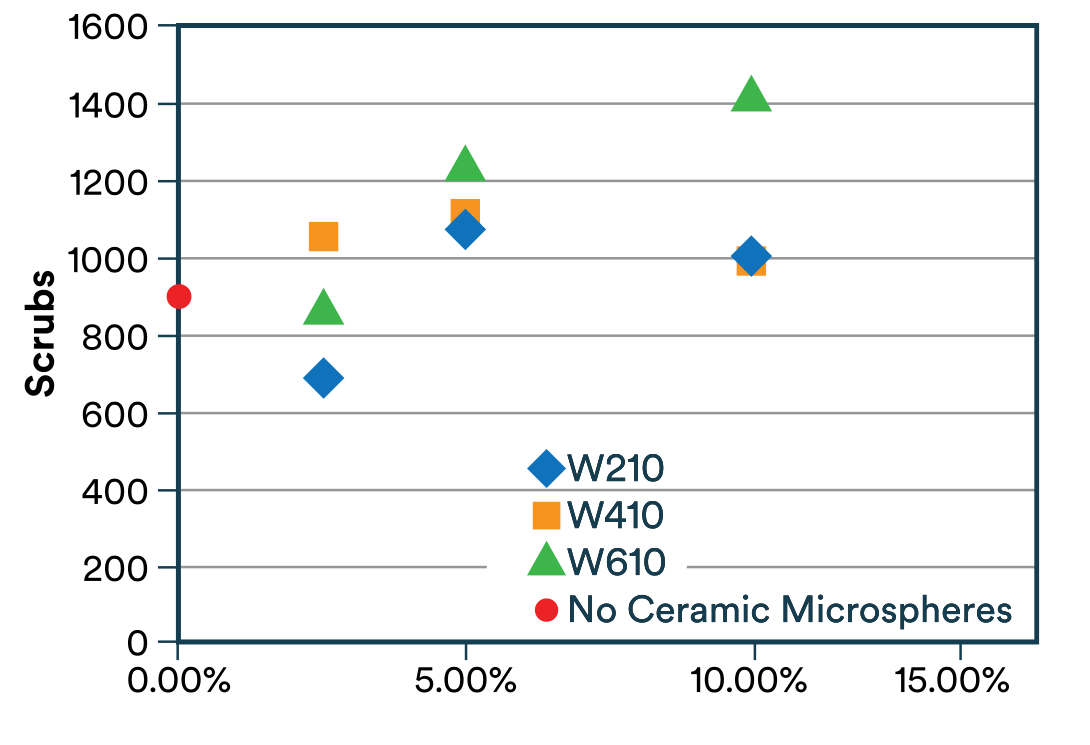
Scrub resistance against ceramic-microsphere volume loading for W-210, W-410 and W-610, including the no-ceramic control. Results apply to the tested acrylic-paint formulation and grades. Redrawn from 3M Ceramic Microspheres in Architectural Paint, p. 4.
Measure Each Property Under Defined Conditions
Consistent preparation helps make a grade comparison useful. The acrylic-paint trials used a laboratory grind and letdown sequence. Two samples were assessed using a Hegman gauge according to ASTM D1210. A polyurethane thickener was added to reach a viscosity of 95–100 Krebs units. After the final degasser addition and mixing, the finished paint rested for at least 20 minutes before its viscosity was measured. These conditions describe the comparison above, not a universal processing specification.
The paints were applied to duplicate Leneta PVC scrub panels and allowed to dry horizontally for at least seven days. The hand-feel assessment concerned dried films approximately 50 µm thick. Film preparation and drying belong alongside grade and loading when interpreting the results.
Scrub and Burnish Methods
For scrub resistance, the comparison used modified ASTM D2486 Method A conditions: a 0.5 mm shim rather than 0.25 mm, a non-scratch Scotch-Brite pad on the brush, standard abrasive media and an Elcometer 1720 abrasion tester. Results were averaged from four tests across two panels, with two tests per panel. The endpoint was paint failure, expressed as the number of passes.
Burnish was assessed with a modified ASTM D6735 procedure using a gauze-wrapped wooden block, a 600 g weight and 100 passes. Gloss at 60° and 85° was measured at three positions using ASTM D523 as the method reference. Burnish was reported as the percentage change in 85° gloss between the initial and final measurements after 100 passes.
These modified methods define the scope of the results. They should not be presented as unmodified standard tests or assumed to predict performance under a different cleaning procedure. The two endpoints remain distinct even though both involve repeated contact with the painted surface.
Why There Is No Single Best Loading
A paint is a combination of binder, pigments, fillers and additives. Replacing part of its filler blend changes that combination, so the result depends on more than the ceramic grade alone.
Particle packing offers one possible explanation for the differing responses, but the middle-loading scrub maximum was not fully explained. It cannot be turned into a universal 5 vol% optimum. Likewise, the improved scrub response as W-610 loading increased does not establish that indefinitely increasing its concentration would continue to improve the coating.
The practical lesson is to judge the whole set of requirements. A formulation with lower burnish may still miss the scrub target. A grade that lowers gloss may not provide the desired touch. The reference paint and each separate endpoint are necessary to understand whether the overall balance has improved.
Balance the Four Surface Requirements
The four surface properties answer different questions. Gloss describes the finish before rubbing. Burnish describes how that appearance changes after rubbing. Scrub resistance concerns the passes to paint failure, while hand feel adds a separate, qualitative assessment of the surface. None of these measurements can stand in for all the others.
Within the tested acrylic system, W-210 combined increased gloss with the smoothest feel at the highest nominal loading. W-610 moved gloss in the opposite direction and felt less smooth, while its scrub resistance increased with loading. W-410 produced little gloss change and had its highest measured scrub result at the middle loading. These combinations illustrate different formulation trade-offs, not a universal ranking of the grades.
The middle-loading scrub maximum is particularly important when interpreting filler content. It shows that the best measured result for one property need not occur at the highest addition level. Equally, the lower burnish of all the ceramic-containing paints does not erase the below-reference scrub performance of some low-loading samples.
These results apply to the tested acrylic paint and its specified replacement basis. A different binder, mineral blend, film preparation or cleaning method can change the balance. Product identity and current technical documentation remain necessary when considering the relevance of these observations to another coating.
Discuss Your Architectural Paint Goal
Conclusion
Ceramic microspheres can offer useful options for balancing gloss, resistance to rubbing and cleaning, and surface feel in architectural paints. Their value comes from selecting a grade and loading that suit the complete formulation, rather than expecting one addition level to improve every property.
The acrylic-paint example shows why that balance matters: gloss changed differently by grade, scrub response was not uniformly proportional to loading, and the smoothest touch did not define every other result. The formulation, replacement basis and measurement conditions are inseparable from those conclusions.
Sources
1. 3M Ceramic Microspheres in Architectural Paint. Grade, loading and coating properties.
2. Technical Glossary (Nanovision). Definitions of binder, gloss, Hegman gauge, viscosity and scrub resistance.
You might also be interested in...
Ceramic Microspheres in Architectural Paint: Balancing Grade, Loading and Surface Properties

You might also be interested in...
Ceramic Microspheres in Architectural Paint: Balancing Grade, Loading and Surface Properties

How can we help you?

24 Vasilissis Olgas Str. | 15124 | Athens | Greece
Phone: (+30) 213 0907763
Reg. Nr.: 181737601000
VAT. Nr.: 802731899
