
PREVIOUS
Blog
Hardness versus Crush Strength: Choosing the Right Property for the Job
Scratch resistance, particle survival and finished-product strength answer different questions.
Learn which measurement belongs to your formulation decision.
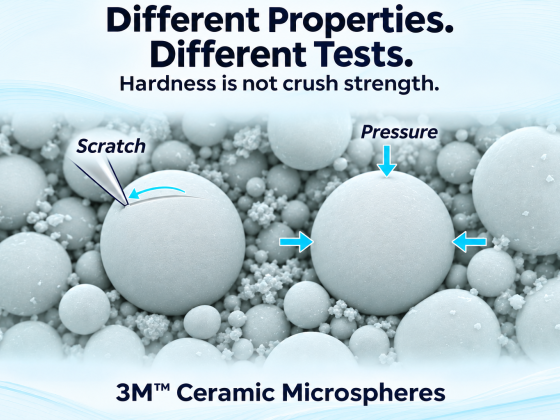
A hard filler can be a useful candidate for a coating, but its hardness does not tell you how much pressure the particles can withstand. Equally, a high crush-strength value cannot establish how easily the finished coating will scratch. The useful starting point is the job the material must do: resist a particular surface interaction, remain intact during processing, or contribute to the mechanical performance of a finished product.
These questions lead to different tests. Keeping them separate makes a technical datasheet more useful and helps avoid selecting a material on the strength of an impressive but irrelevant number.
Table of Contents:
Related 3M™ Ceramic Microspheres Articles

Unlocking the Potential of Functional Fillers in Waterborne, UV-Curable Coatings
Reading a microsphere data sheet with the right context
Enhancing Paints & Coatings with 3M™ Ceramic Microspheres
What Hardness Tells You
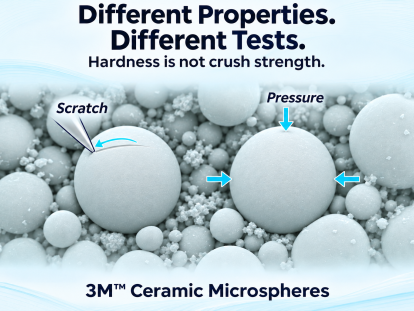
Hardness describes resistance to a specified mechanical interaction. On the Mohs scale, that interaction is scratching: materials are ranked by their ability to scratch other materials. The scale is relative, with unequal intervals. A value of 6 is not twice the hardness of 3, and there is no conversion from a Mohs ranking to a pressure in psi or MPa.
Indentation methods ask a different question. A defined indenter is pressed into a material under a specified force, and the resulting indentation is measured according to the method. A hardness result therefore needs its method as well as its number. Two entries labelled “hardness” may describe different measurements and cannot automatically be ranked together.
Particle hardness helps coating developers select candidates. Testing the finished coating then shows how the complete formulation performs against scratching or abrasion in its intended application.
What Crush Strength Tells You
For microspheres, a crush-strength entry may pair a test pressure with a specified fraction of material surviving. Read both together. The pressure describes the loading level associated with that survival criterion, rather than a promise that every particle remains intact under every form of loading.
The basis of survival matters. “80% survival by volume” refers to a volume-based result under the applicable procedure. It is not a statement that 80% of the individual particles survive by count. Nor does it mean that all particles survive. Counting particles and measuring their contribution to volume answer different questions.
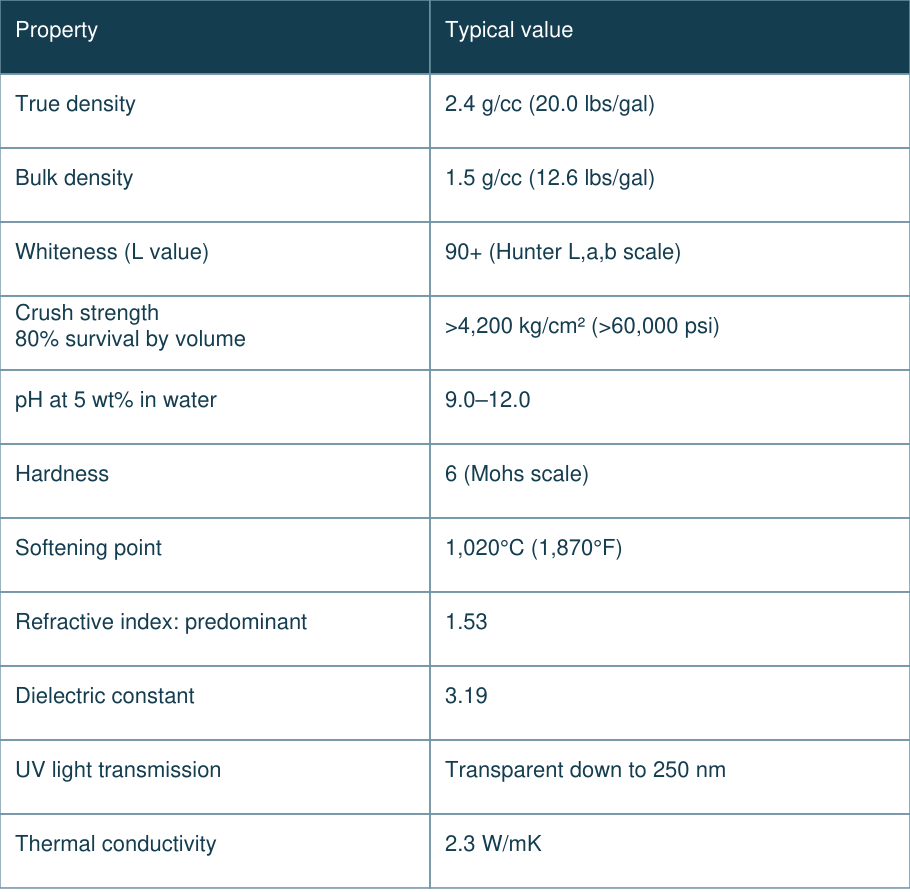
Typical physical properties of 3M™ Ceramic Microspheres W-210, W-410 and W-610, redrawn from 3M™ Ceramic Microspheres. Typical values are not specifications.
The loading method also matters. A result explicitly described as isostatic belongs to that test method. A crush-strength value whose loading geometry is unspecified must remain unspecified until the supplier confirms the procedure. Similar units do not establish that two measurements were made in the same way.
Reading Two Values for the Same Ceramic Filler
For 3M™ Ceramic Microspheres W-210, W-410 and W-610, the reported typical properties include:
• Hardness: 6 on the Mohs scale.
• Crush strength: >60,000 psi at 80% survival by volume.
The first value is a scratch-hardness ranking. The second combines pressure with a volume-survival criterion. They describe separate properties; neither value can be calculated from the other.
These are typical values, not specification limits. Their scope is the stated grades, not every ceramic microsphere and not a finished coating or composite. The full crush-test protocol and loading geometry are not established by the available product information, so this ceramic result should not be described as hydrostatic or isostatic without further confirmation.
This example is useful when reviewing a supplier comparison. Keep the complete entry beside the grade name, including the greater-than sign and survival basis. Shortening it to “60,000 psi hardness” changes the property; shortening it to “up to 60,000 psi” reverses the meaning of the reported inequality.
Why Matching Units Is Not Enough
Before ranking two crush-strength values, compare their survival criteria and methods. A result associated with 80% survival by volume cannot simply be treated as equivalent to one reported under a 90% survival heading. Converting psi to MPa changes the unit, not the test or its acceptance criterion.
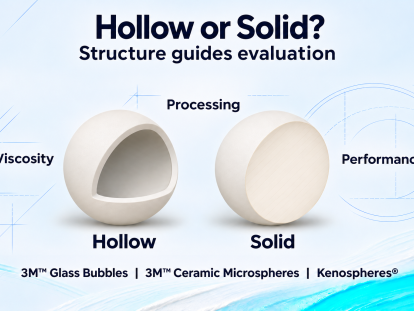
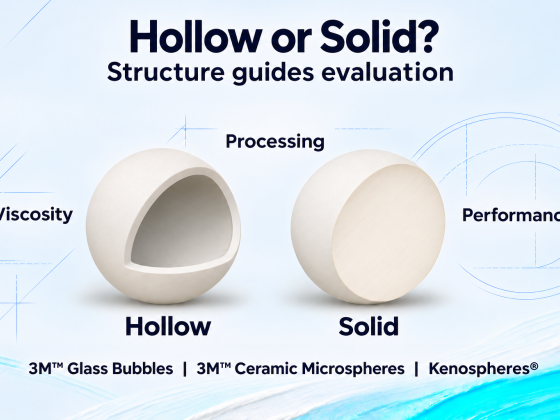
The same care applies when comparing solid ceramic particles with hollow glass bubbles. Their material structures and reported test information differ. An explicitly identified glass-bubble test does not establish the missing protocol for a ceramic filler. Compare like-for-like measurements where they are available; otherwise, record the unresolved difference rather than filling it with an assumption.
Connecting the Numbers to Processing
Mixing, milling, pumping and application expose a formulation to different mechanical conditions. A single material-property result does not reproduce this complete processing history. Use the supplier's guidance for the exact material family and grade, then evaluate the proposed route in the actual formulation.
A practical evaluation can start with three separate questions:
- What must happen during manufacture? Establish the required dispersion and, where relevant, particle integrity after the intended processing stages. Record the equipment and processing history so that a successful laboratory trial can be meaningfully compared with later trials.
- What must the finished product withstand? Choose tests that correspond to the application, such as coating scratch or abrasion resistance, or composite compressive performance. Set the required outcome before comparing candidates.
- Which result supports the decision? Keep the particle-property information, processing observations and finished-product results in separate fields. A satisfactory result in one field does not automatically pass the other two.
Use these checks to define a trial for your chosen grade, formulation and processing conditions.
A Short Comparison Checklist
Before using a mechanical-property value to select a microsphere, confirm:
• The exact material family and grade, and the applicable technical-data revision.
• The property being measured and its scale or unit.
• The test method, loading conditions and any unresolved protocol details.
• The survival percentage and whether its basis is volume, count or another defined quantity.
• Whether the value is typical information or a specification requirement.
• The separate processing and finished-product evidence needed for the intended use.
Choose the Relevant Property
Bring the grade, complete property entry and intended process so we can discuss the evidence your application needs.
Discuss Your Application
Conclusion
Choose the measurement that answers the engineering question: hardness for a defined surface interaction, crush strength for particle survival under a defined loading test. Combine these data with trials of your formulation and process to guide material selection.
For a useful technical discussion, bring the material grade, the complete property entry and a non-confidential description of the application and intended process. This makes it easier to identify the missing evidence before choosing the next trial.
Sources
1. 3M™ Ceramic Microspheres. Typical physical properties.
2. Technical Glossary (Nanovision). Definitions of Mohs hardness and isostatic crush strength.
3. Standard Test Method for Microindentation Hardness of Materials. ASTM E384. Public microindentation overview.
4. 3M™ Glass Bubbles K Series, S Series and iM Series. Crush-strength reporting.
5. Effect of Processing Conditions on the Extent of Glass Bubble Survival During Twin Screw Compounding. Glass-bubble processing study.
6. 3M™ Ceramic Microspheres in Architectural Paint. Comparative study.
You might also be interested in...
Ceramic Microspheres in Architectural Paint: Balancing Grade, Loading and Surface Properties
You might also be interested in...
How can we help you?

24 Vasilissis Olgas Str. | 15124 | Athens | Greece
Phone: (+30) 213 0907763
Reg. Nr.: 181737601000
VAT. Nr.: 802731899
