
PREVIOUSNEXT
Blog
Comparing Microsphere Paint Trials Without Losing the Control
How to compare W-410 and TiO₂ substitution trials on a clear formulation basis
A promising paint result is useful only when the comparison behind it is clear. Choosing the right control, balancing mass and volume, and setting acceptance limits before testing help turn microsphere trials into practical formulation decisions.
A coating must do several jobs at once. It needs to hide the substrate, give the intended finish and withstand cleaning, while remaining practical to manufacture and apply. Improving one property is not enough if another falls outside the product specification.
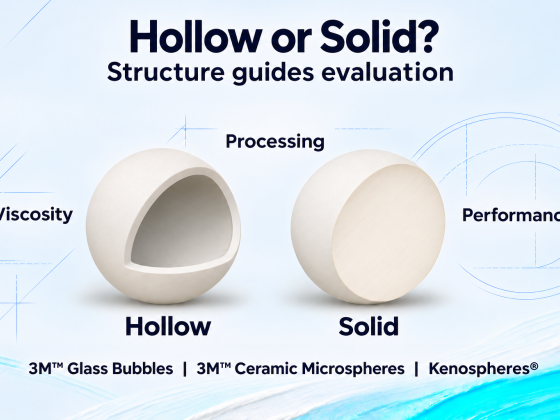
This becomes particularly important when evaluating 3M™ Ceramic Microspheres W-410 alongside TiO₂ substitution with 3M™ Glass Bubbles iM16K. W-410 is a solid ceramic microsphere; iM16K is a hollow glass bubble. They serve different formulation questions, and their results need different controls.
Table of Contents:
Related Technical Articles
The Technology Behind Anti-Condensation Paints (Part 1)

Boosting Anti-Condensation Paints with 3M™ Glass Bubbles
Reading a microsphere data sheet with the right context
Start with the comparison, not the ingredient
A W-410 trial might ask whether replacing a named extender improves scrub resistance at a fixed pigment volume concentration, or PVC. Another might ask whether the paint can tolerate a higher PVC while maintaining acceptable performance. These are different questions: the first examines a specified substitution, while the second also changes the binder-to-pigment balance.
TiO₂ replacement introduces another distinction. The percentage of pigment removed describes one part of the formulation change. The volume and mass of the substitute describe another. Keeping those quantities separate allows a team to compare paints rather than percentages.
Separate W-410 loading from changes in PVC
One reported flat-acrylic-paint series compared a W-410-free formulation, DG-1, with five variants containing increasing W-410. DG-2, DG-3 and DG-4 are listed at PVC 40%, DG-5 at 49%, and DG-6 at 56%. DG-1 has an unresolved discrepancy: the starting formulation gives PVC 40%, while the comparison gives 42%.
The trial produced useful results. At 5 vol% W-410, DG-3 reached 1,000 scrub cycles and needed 200 wash cycles to remove the soilant, compared with 400 wash cycles for the starting paint. The reported fineness of grind improved up to 10 vol% W-410, reaching 7 Hegman units, and remained at 7 Hegman units at 15 and 20 vol%. These observations make W-410 worth evaluating, but they describe particular formulations and conditions, not a universal addition rate.
Across the full series, W-410 loading, PVC and the extender package do not remain independent. The higher-PVC paints also change the balance between filler and binder. DG-2 through DG-4 offer a narrower comparison at the same nominal PVC, although replacing one extender with another still makes the result specific to that substitution.
Test conditions matter as well. The scrub procedure used a 0.5 mm shim instead of 0.25 mm and a non-scratch pad attached to the brush, with the standard abrasive medium retained. Its cycle counts should therefore be interpreted within that procedure, not equated directly with those from another trial.
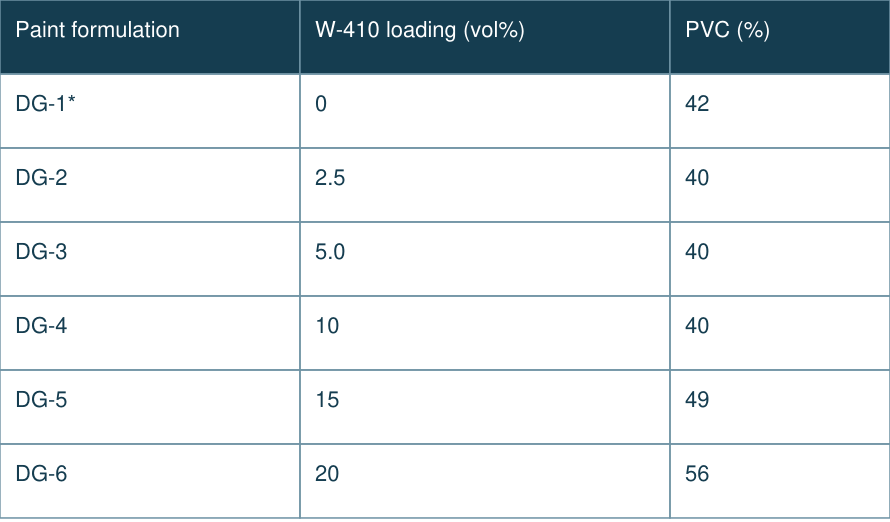
W-410 loading and pigment volume concentration across formulations DG-1 to DG-6.
Understand what TiO₂ replacement means
A separate flat-acrylic-paint comparison used nominal PVC 45 and replaced removed TiO₂ with an equal volume of iM16K. Its four formulations, A–D, all contained W-410. A had no glass bubbles; B and C used iM16K; D replaced TiO₂ with other fillers. A is consequently a no-glass-bubble reference, not a W-410-free control.
The results summary describes all four as containing 5 vol% W-410. That is the reported summary label: the formulation amounts list 5.09 gal of W-410 for C, compared with 5.00 gal for A, B and D. A separate W-410-free paint is mentioned, but without the matched formula and result table needed for a controlled comparison.
The reported 5 wt% and 15 wt% substitution levels describe TiO₂ mass removed, while iM16K is added on an equal-volume basis. The formulation table lists 5.50, 5.23 and 4.68 gal of TiO₂ for A, B and C, respectively, alongside 0, 0.28 and 0.83 gal of iM16K. Small differences in the reported volumes reflect rounding, not equal-mass replacement.
For a new formulation, calculate both mass and volume using the appropriate particle-density basis. For intact hollow particles, that volume includes the enclosed space. Loose-powder bulk density and the density of the glass shell alone are not substitutes for that basis. PVC must also use binder nonvolatile volume, rather than the volume of the wet latex as supplied.
Read the coating properties together
The reported opacity means for A, B and C were 96.18, 96.34 and 96.01. Their scrub means were 1,079, 960 and 1,011 cycles. Gloss at 60° was 3.50, 3.77 and 3.60; at 85° it was 3.03, 3.10 and 2.77.
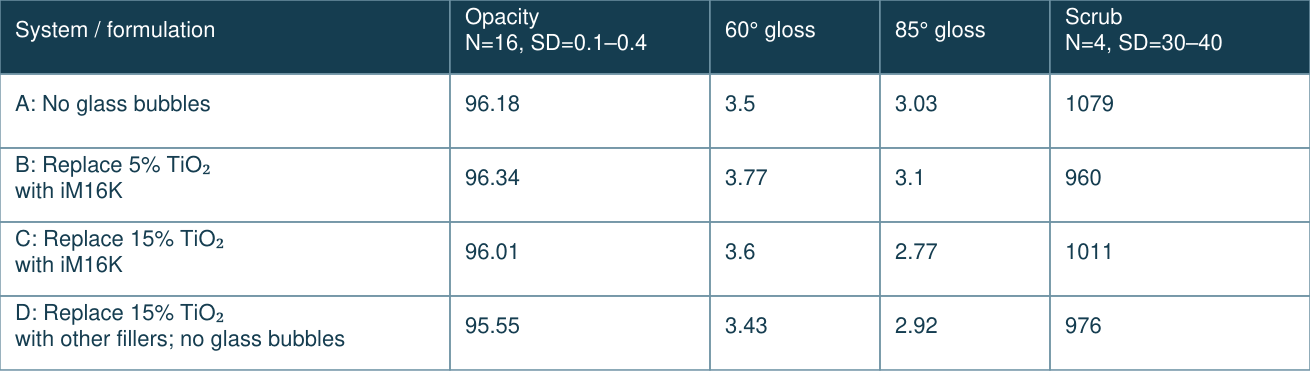
Opacity, gloss and scrub resistance across four tested acrylic paint formulations (A to D).
The combination matters more than any single number. B had slightly higher mean opacity than A, but a lower mean scrub result. Whether that balance is acceptable depends on the intended paint specification and the uncertainty around the comparison.
Opacity is reported with N = 16 and SD = 0.1–0.4, and scrub with N = 4 and SD = 30–40. These summaries do not identify independent paint-batch counts or provide formulation-specific confidence intervals. They are insufficient to establish statistical equivalence or compliance with a customer's scrub limit. The practical lesson is to define acceptable differences before testing, rather than treating similar means as proof of equivalent performance.
The two studies illustrate different sources of comparison error. In the W-410 series, filler loading and, at higher levels, PVC change together. In the TiO₂ substitution series, the removed pigment mass and replacement volume must be distinguished while W-410 remains present. Neither comparison should be reduced to a claim about one ingredient without considering the full formulation. The next step is to design controls that isolate the question being tested.
Build a matched trial
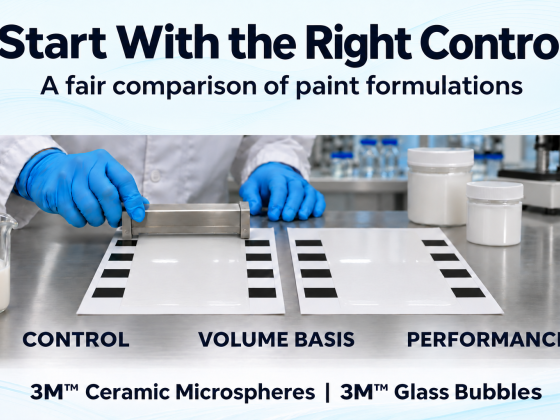
Use the following approach to design a matched paint evaluation.
For W-410, select a relevant reference paint and name the extender being replaced. Calcined kaolin can serve as an illustrative comparator, but its actual grade must be specified. Compare the reference with a candidate in which W-410 replaces a defined dry volume of that extender. Keep the target PVC, binder system, TiO₂ level and total extender volume fixed.
If a higher PVC is also of interest, repeat the reference and candidate at that second PVC. Comparing the pair at each level helps show whether the substitution response changes with PVC, rather than confusing both changes in one sequence.
For TiO₂ substitution, use the same reference paint and an explicit mass-and-volume balance for every candidate. Keep W-410 status constant. Include a matched conventional-extender comparison when the question is whether iM16K performs differently from another way of filling the removed pigment volume. Any binder or dispersant adjustment should be recorded as an additional change.
Across both trial types, match the process, substrate, colour, film build, drying or cure, conditioning and test method. Measure finished-paint viscosity. Include independent paint batches as well as replicate readings, because repeated measurements on one panel do not measure batch-to-batch variation.
Agree on acceptance before testing
Set minimum opacity and scrub requirements, an acceptable gloss range, and any other relevant properties, such as adhesion, washability or storage stability. Improved opacity should not compensate for a failed cleaning or application requirement.
For each property, agree on either a fixed specification or an acceptable difference from the reference. Plan the batch and panel numbers, then assess the measured difference with appropriate uncertainty. An equivalence claim requires a pre-declared equivalence margin; a nonsignificant difference alone is not enough. For a one-sided question about avoiding an unacceptable loss, the testing team can define a non-inferiority margin.
Only after the coating meets its technical requirements should current cost be compared on the same material, yield and application basis. Earlier formulation examples do not establish today's savings or a transferable replacement percentage.
Plan Your Paint Trial
Planning a microsphere trial in your paint formulation? Share your current system, target properties and evaluation plan with Nanovision to discuss the next step.
Discuss Your Paint Evaluation
Conclusion
A useful microsphere comparison begins with a question that its control can answer. Separate changes in W-410 loading from changes in PVC, distinguish TiO₂ mass removed from substitute volume added, and evaluate the coating properties together. With matched formulations and acceptance limits established in advance, the trial can support a practical decision about the next formulation to develop.
Sources
1. Performance Study of 3M™ Ceramic Microspheres W-410 in a Water-Based Acrylic Flat Architectural Paint. Formulation and coating results.
2. TiO₂ Replacement: 3M™ Glass Bubbles, Cost-in-use to maintain opacity. Formulation comparison. Request Documentation.
3. Technical Glossary (Nanovision). Definitions of pigment volume concentration, opacity, gloss, scrub resistance and viscosity.
You might also be interested in...
Ceramic Microspheres in Architectural Paint: Balancing Grade, Loading and Surface Properties
You might also be interested in...
How can we help you?

24 Vasilissis Olgas Str. | 15124 | Athens | Greece
Phone: (+30) 213 0907763
Reg. Nr.: 181737601000
VAT. Nr.: 802731899
