
PREVIOUS
Blog
Connecting microsphere structure with a practical evaluation
How particle structure influences density, processing and finished performance
Hollow microspheres bring density and particle survival into focus. Solid ceramic microspheres offer a different route to particle packing and coating surface performance. A useful comparison connects these characteristics with the actual process and the properties required from the finished product.
A microsphere's shape tells only part of its story. The cavity inside a hollow particle changes the questions a formulator needs to ask, while a solid particle brings its own combination of material properties. Choosing between them starts with the intended application: what needs to improve, what must remain acceptable, and what the material will encounter during manufacture.
For R&D, production and quality teams, three kinds of information need to come together: the properties of the selected filler, its behaviour during processing, and measurements on the finished coating or composite. Keeping those stages connected makes the comparison more useful than a ranking based on one data-sheet value.
Table of Contents:
Related Technical Articles

The Technology Behind Anti-Condensation Paints (Part 1)

Enhancing Wall Fillers with 3M™ Glass Bubbles

Reading a microsphere data sheet with the right context
Start with Particle Structure
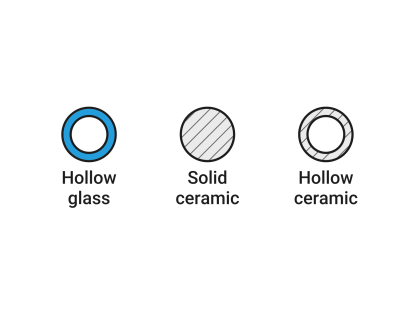
3M™ Glass Bubbles are hollow glass microspheres, whereas 3M™ Ceramic Microspheres are solid ceramic particles. The internal cavity is the key structural distinction. A spherical shape alone does not imply the same density, resistance to breakage or processing requirements.

Conceptual cross-sections of hollow and solid microspheres. Not to scale.
Kenospheres® are our separate family of hollow alumino-silicate ceramic microspheres. Their composition and structure distinguish them from both hollow glass bubbles and solid ceramic microspheres. Each family therefore needs its own grade-specific assessment.
Record the supplier, product family and exact grade at the outset, together with the technical information used to select it. This keeps later observations tied to an identifiable material rather than to the broad term microsphere.
Read Density alongside Crush Strength
For hollow glass bubbles, true density, crush strength and particle-size distribution describe different aspects of a candidate grade. A low density may be attractive for weight reduction, but the selected particles also need to suit the processing conditions and the intended finish. Consider these properties together when building a shortlist. In a liquid coating, assess particle-size distribution alongside dispersion, flow and the finish of the applied film. For solid ceramic microspheres, size distribution contributes to packing and resin demand; surface quality still needs to be checked in the complete formulation. A median size does not describe the full distribution, and D90 is not a maximum particle size.
Check What Each Value Describes
The filler’s true density, its bulk density and the measured density of the finished formulation are different quantities. Check the stated method and conditions before comparing results. A value used to describe the particles themselves cannot simply replace a measurement of the powder in a container or of the complete formulation. For an intact closed hollow particle, the particle-volume basis includes its enclosed cavity. The density of the glass shell material alone excludes that cavity and is not interchangeable with the whole-particle value. If a data sheet reports skeletal or apparent density, check the stated volume definition and measurement method rather than assuming that either term is interchangeable with whole-particle or bulk density.
Low-density glass bubbles also require attention during weighing and transfer. For a given mass, a lightweight filler can occupy considerably more volume than a denser mineral filler. Check the capacity and behaviour of the actual handling system, including how the powder is metered and introduced.
A supplier’s crush-strength value helps assess whether a grade is a suitable candidate. Read it with the test definition and any stated survival criterion, then examine particle condition under the intended processing conditions. That test value alone cannot predict survival throughout an entire production line.
Connect Hardness with a Defined Performance Test
The hardness, spherical shape and size distribution of solid 3M™ Ceramic Microspheres can support efficient particle packing, lower resin demand and improved scrub and burnish resistance in coatings. Their contribution depends on the selected grade, loading and complete formulation.
Particle hardness, scrub resistance and burnish resistance describe different properties. A hard filler provides a reason to investigate a coating’s surface performance; the finished film still needs to be tested for the property that matters in use.
If repeated cleaning is the concern, compare scrub performance. If rubbing changes the surface appearance, assess burnishing under documented conditions. Where abrasion or another mechanical property matters, choose the corresponding test. Keep the substrate, film preparation and conditioning consistent enough to support a meaningful comparison.
Follow Particle Condition through Processing
Processing needs to suit the selected material. For 3M™ Ceramic Microspheres, the incorporation guidance allows addition during the standard grind. For 3M™ Glass Bubbles, the guidance calls for low-shear mixing and addition during the let-down stage. These distinctions apply to the stated families and must be checked against the current grade and application requirements before use. They should not be transferred automatically to hollow ceramic microspheres or other suppliers’ materials.
Look beyond the Mixing Vessel
Compression, shear and impact can break glass bubbles. Metering, transfer and pumping therefore deserve attention alongside mixing. A particle that survives incorporation may still encounter damaging conditions elsewhere in the production route. Breakage can reduce the retained hollow volume and affect the finished formulation's density, so the actual outcome needs to be measured after processing.
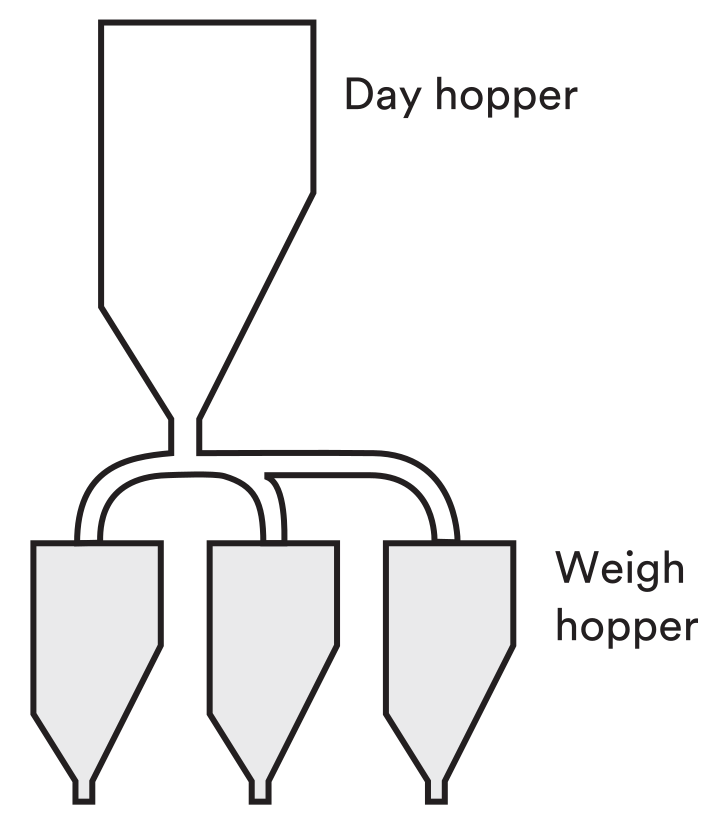
Example of a day hopper supplying three weigh hoppers for 3M™ Glass Bubbles. Redrawn from the 3M Glass Bubbles Metering and Mixing Guide.
Map the stages the material passes through, then agree where samples can be taken to assess particle condition. Compare those observations with density and application results so that a change in the finished product can be investigated in the context of its processing history.
This approach helps plan an evaluation; it does not specify plant settings. Current grade documentation, safety information and equipment guidance remain essential when defining operating conditions.
Build the Comparison around the Finished Application
A useful trial begins with a clear question. Can a selected hollow grade help achieve the required formulation density while maintaining application properties? Can a solid ceramic grade improve a coating’s surface performance without compromising film quality? The trial should establish the answer rather than assume it.
For example, a lightweight liquid coating trial could compare the current formulation with one containing a selected hollow glass grade on a defined volume-replacement basis. Measure finished density after the planned mixing and transfer steps, assess particle condition and check application quality against preset limits. This is a proposed evaluation, not a reported result.
For a separate surface-performance trial, compare a reference paint with a selected solid ceramic grade replacing a defined extender volume at fixed PVC. Match binder, film preparation and test conditions, then assess scrub or burnish resistance together with gloss, viscosity and film quality. This proposed comparison tests a different objective; it does not assume an improvement or prescribe a universal loading.
- Define the objective and acceptance criteria. Include the properties that must be maintained alongside the property being investigated.
- Document the baseline and the candidate. Record the exact grade, the supporting technical information and the basis of comparison. State whether additions are measured by mass or by volume.
- Record the processing history. Note equipment, addition stage and handling changes that could affect the result. Assess particle condition where relevant.
- Measure the finished material. Use methods appropriate to the application, document preparation and conditioning, and retain the results together with their limitations.
Keep density, mechanical performance and thermal behaviour as separate endpoints. Hollow structure alone does not establish a finished composite’s thermal conductivity, strength or durability. Report any improvement alongside changes in the other properties that matter to the application.
Promising laboratory results provide a reason to continue to production evaluation. Confirm performance under the intended manufacturing conditions before treating the laboratory comparison as evidence for the production process.
Discuss Your Microsphere Evaluation
Tell us the application, the property you want to improve and the main processing constraints. Contact Nanovision to discuss the next evaluation step and request the relevant grade documentation.
Explore Our Product Portfolio
Conclusion
Particle structure helps narrow the questions that matter. Hollow glass bubbles bring density and particle survival into focus. Solid ceramic microspheres provide a basis for investigating packing, resin demand and coating surface performance. Hollow ceramic microspheres remain a distinct family with their own grade-specific requirements.
The useful choice emerges when those characteristics are tested against the actual formulation and process. Define the objective, compare candidates on a clear basis and judge the result through the properties of the finished product.
Sources
1. 3M Glass Bubbles for design and construction. Hollow glass structure.
2. 3M Ceramic Microspheres. Solid ceramic structure.
3. 3M Ceramic Microspheres Application Guide. Properties and incorporation.
4. 3M Glass Bubbles Metering and Mixing Guide. Handling and processing.
5. 3M Glass Bubbles in paints and construction. Application guidance.
6. Kenospheres product overview (Nanovision). Material identity.
7. Product portfolio (Nanovision). Product-family context.
8. Formulation-support request (Nanovision). Formulation-support contact route.
9. Documentation request (Nanovision). Technical-documentation request route.
10. Technical Glossary (Nanovision). Definitions of bulk density, crush strength, particle size, hardness and thermal conductivity.
You might also be interested in...


Ceramic Microspheres in Architectural Paint: Balancing Grade, Loading and Surface Properties

You might also be interested in...


Ceramic Microspheres in Architectural Paint: Balancing Grade, Loading and Surface Properties

How can we help you?

24 Vasilissis Olgas Str. | 15124 | Athens | Greece
Phone: (+30) 213 0907763
Reg. Nr.: 181737601000
VAT. Nr.: 802731899
