Blog
Enhancing Wall Fillers with 3M™ Glass Bubbles
Achieve superior quality in lightweight compounds and other wall filler applications.
Discover how 3M™ Glass Bubbles can enhance wall filler performance by reducing shrinkage, cracking, and sagging while improving workability and sandability.
3M™ Glass Bubbles are described in supplier guidance as potential contributors to properties such as weight reduction, application productivity, dimensional stability/sag resistance and sandability. Results depend on the specific wall filler formulation and application conditions; no universal finished-system performance or quantified labour saving is established here.
Table of Contents:
Related 3M™ Glass Bubbles Articles
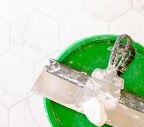
Enhancing Wall Fillers with 3M™ Glass Bubbles
Revolutionizing Paint and Coating Industry with 3M™ Glass Bubbles
Packaging and Handling Options of 3M™ Glass Bubbles
Benefits of 3M™ Glass Bubbles in Wall Fillers
Incorporating 3M™ Glass Bubbles into wall filler formulations may provide potential benefits for evaluated formulations and applications. The supplier guidance discusses possible effects on application-related properties, while actual results depend on the complete formulation and intended use.
Shrinkage Behaviour
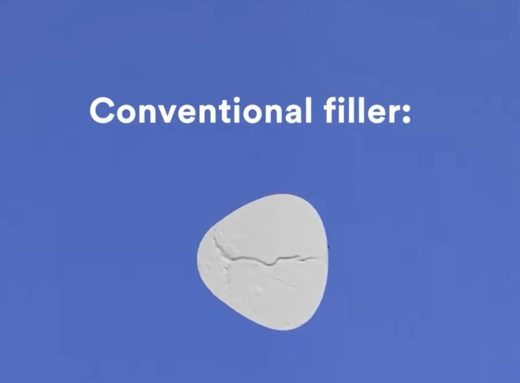
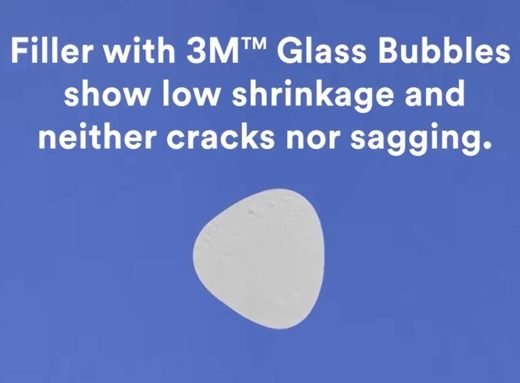
Glass Bubbles can contribute to formulation changes that may influence properties such as density, handling characteristics and shrinkage behaviour under evaluated conditions.
Cracking Resistance
Final cracking resistance depends on the complete wall filler formulation, application conditions, drying conditions, substrate and usage environment.
Low Density
3M™ Glass Bubbles may contribute to lower-density filler formulations, which can influence handling characteristics. The resulting properties depend on the complete formulation and application evaluation; no general assurance of unchanged performance across all finished fillers is implied.
Low Sag
3M™ Glass Bubbles may contribute to reduced sag tendency in suitable evaluated formulations. Any improvement in application behaviour or vertical hold depends on the complete formulation and application conditions.
Enhanced Workability
3M™ Glass Bubbles may contribute to workability and application characteristics in evaluated filler formulations. Results depend on the complete formulation and use conditions.
Improved Sandability
Fillers containing 3M™ Glass Bubbles may demonstrate improved sandability characteristics in evaluated formulations and applications. The final finish and effort required depend on the complete system and application conditions; no universal labour reduction is established.
Nail and Screw Durability
Nail and screw performance should be evaluated in the intended wall filler application. Evaluation should consider the intended application, including relevant testing for shrinkage behaviour, cracking resistance, sanding and handling performance. No material addition can be interpreted as a universal guarantee of zero shrinkage or zero cracking across all systems.
Potential Productivity Considerations
Ease of application and other formulation-related characteristics may contribute to potential productivity benefits in suitable applications. Quantified labour cost savings require evaluation of the complete formulation, application method, labour assumptions and project conditions.
Recommended Microspheres
For interior spackle/wall filler applications, the March 2023 guide identifies K1, K15 and K20 as candidate grades in the interior spackle/wall filler matrix. Grade selection should be evaluated for the intended formulation, actual processing conditions and applicable processing pressure requirements. This does not indicate airless-spraying suitability, processing survival or a guaranteed optimal result.
K1: Ideal for low-density applications.
K15: Provides a balance between strength and lightweight properties.
K20: Offers high strength and durability.
Conclusion
Integrating 3M™ Glass Bubbles into wall fillers may influence formulation properties such as density, handling characteristics, shrinkage behaviour and cracking resistance under evaluated conditions. Workability and potential productivity benefits depend on the complete formulation and application. Final durability and finished-system performance require evaluation of the specific wall filler system and intended use.
Optimize your wall filler
formulation today!
Sources
3M. 3M Glass Bubbles: The start to a better finish. © 3M 03/2023; GBCPC202302EN. pp. 8–12. (Do(S2) 3M. 3M Glass Bubbles K/S/iM product information. November 2025; 18693HB; 98-0212-4117-6 Rev. E. pp. 1 and 3. (Download Source)
3M. 3M Glass Bubbles K/S/iM product information. November 2025; 18693HB; 98-0212-4117-6 Rev. E. pp. 1 and 3. (Download Source)
You might also be interested in...
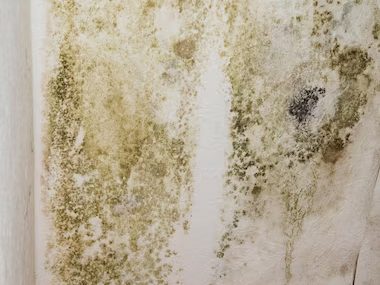
Increasing Time Until Condensation: Advanced Applications of 3M™ Glass Bubbles (Part 2)

You might also be interested in...
Increasing Time Until Condensation: Advanced Applications of 3M™ Glass Bubbles (Part 2)
How can we help you?

24 Vasilissis Olgas Str. | 15124 | Athens | Greece
Phone: (+30) 213 0907763
Reg. Nr.: 181737601000
VAT. Nr.: 802731899
