
Blog
Evaluating the Impact of 3M™ Glass Bubbles on Solar Heat Reflection
Explore how 3M™ Glass Bubbles enhance solar heat reflection in waterborne acrylic elastomeric roof coatings.
Optimize your roof coatings with 3M™ Glass Bubbles, which are engineered to reduce heat absorption, keeping roofs cooler and extending their lifespan.
The expanding building market has placed a higher demand on electricity for cooling, particularly in warmer climates. This has driven coatings companies to explore solar heat reflective coatings as a means to combat rising energy costs. One innovative solution is the integration of 3M™ Glass Bubbles into waterborne acrylic elastomeric roof coatings. This article delves into the benefits of using 3M™ Glass Bubbles, backed by a comprehensive study that examines their impact on solar
heat reflection and energy savings.
Table of Contents:
Related 3M™ Glass Bubbles Articles
Packaging and Handling Options of 3M™ Glass Bubbles
Revolutionizing Paint and Coating Industry with 3M™ Glass Bubbles

Enhancing Wall Fillers with 3M™ Glass Bubbles
The Growing Need for Solar Heat Reflective Coatings
As the demand for energy-efficient solutions grows, the architectural coatings industry has turned its focus towards developing solar heat reflective coatings. These coatings are characterized by high solar reflectance and emittance values, which help reduce cooling costs in buildings. The cited study found higher solar reflectance for the Glass Bubbles coating samples than for the CaCO3-reference coating, with comparable thermal emittance in the tested coatings.
Understanding 3M™ Glass Bubbles
3M™ Glass Bubbles are hollow, spherical microspheres made from borosilicate glass. These innovative fillers are lightweight and durable, offering unique light scattering efficiencies due to their hollow structure. Their integration into roof coatings aims to improve solar reflectance and thermal management.
Benefits of 3M™ Glass Bubbles in Roof Coatings
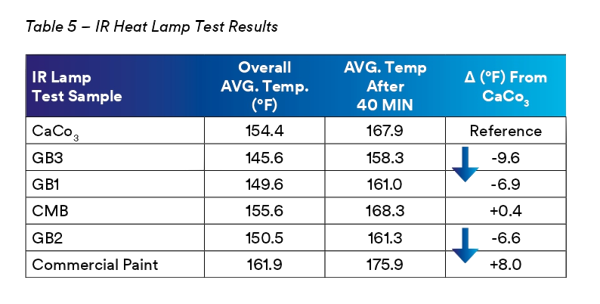
The cited study compared solar reflectance and thermal emittance in roof coatings containing 3M™ Glass Bubbles. The Glass Bubbles coating samples had higher TSR than the CaCO3-reference coating, with comparable thermal emittance in the tested coatings. Any calculated energy benefit represents a modelling scenario and not measured building energy savings.
Enhanced Solar Reflectance
3M™ Glass Bubbles have shown exceptional performance in enhancing the solar reflectance of roof coatings. Their hollow structure helps reflect a significant portion of the sun's energy, thereby reducing heat absorption.
Comparable Thermal Emittance
Thermal emittance was comparable in these tested coatings; the comparison does not demonstrate an emittance improvement from the Glass Bubbles.
Energy Savings
Any calculated energy benefit represents a modelling scenario and not measured building energy savings.
Study Highlights: Solar Heat Reflection with 3M™ Glass Bubbles
Solar Reflectance Results
The study measured total solar reflectance (TSR) using a Perkin Elmer Model 950 spectrophotometer. The results indicated that coatings with 3M™ Glass Bubbles (particularly GB3) performed significantly better, achieving higher TSR values across various substrates.
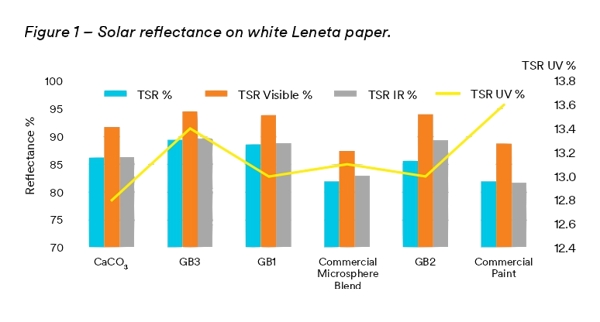
Solar reflectance on white Leneta paper demonstrates higher reflectance with 3M™ Glass Bubbles compared to conventional fillers
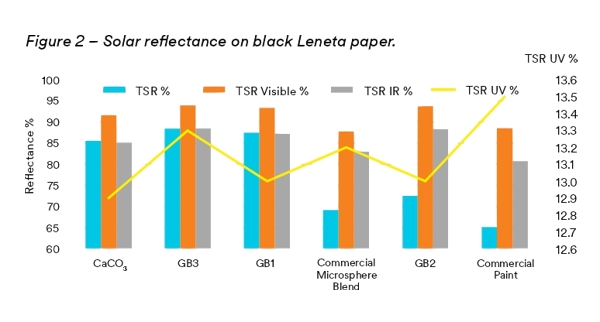
Solar reflectance on black Leneta paper shows the superior performance of 3M™ Glass Bubbles in reflecting sunlight.
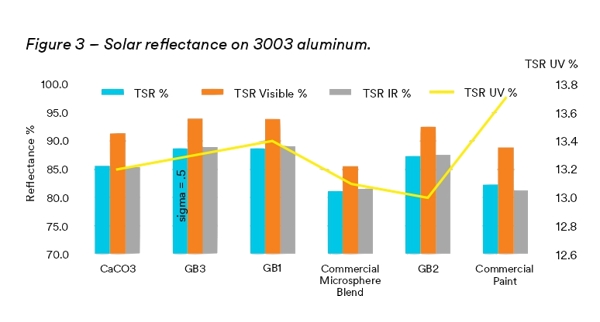
Reflectance measurements on 3003 aluminum indicate higher solar reflectance with coatings containing 3M™ Glass Bubbles.
Emissivity Test Findings
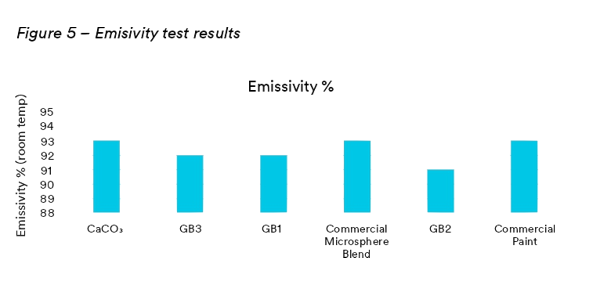
Thermal emittance was comparable in these tested coatings; the comparison does not demonstrate an emittance improvement from the Glass Bubbles. Table 4 reported emittance values of 0.93 for the CaCO3-reference coating, 0.92 for GB3, 0.92 for GB1 and 0.91 for GB2.
Accelerated Weathering Studies
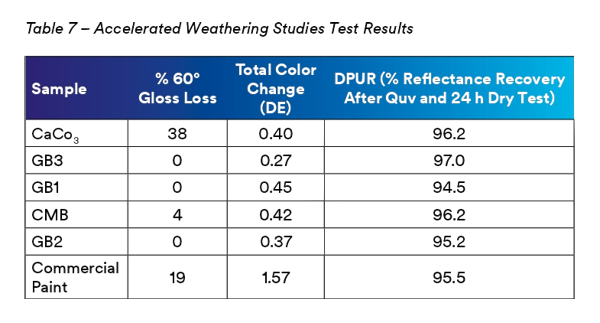
The study also included accelerated weathering tests to assess the durability of the coatings. The results showed that coatings with 3M™ Glass Bubbles maintained high reflectance and minimal gloss loss even after 1000 hours of QUV exposure.
Optimized Formulation with 3M™ Glass Bubbles
Solar reflective coating performance should be discussed using the correct measurement metrics. In the cited 3M CoatingsTech study, Table 4 reported Total Solar Reflectance (TSR) values for the tested coating samples: the CaCO3-reference coating at 0.856, coating sample GB3 at 0.887, coating sample GB1 at 0.887 and coating sample GB2 at 0.873.
Brightness values and other recovery measurements are separate metrics and should not be described as TSR. Solar Reflectance Index (SRI) is an index value, not a percentage. Any calculated energy benefit represents a modelling scenario and not measured building energy savings.
For a comprehensive understanding of how 3M™ Glass Bubbles can enhance solar heat reflection in waterborne acrylic elastomeric roof coatings, and to access the specific formulation used, and to access the specific formulation used, request to download the white paper. This document offers an in-depth analysis of the benefits and application methods of 3M™ Glass Bubbles, providing you with the tools to effectively optimize your products.
Conclusion
3M™ Glass Bubbles offer a promising solution for enhancing the solar reflectance and thermal management properties of roof coatings. Any calculated energy benefit represents a modelling scenario and not measured building energy savings.
Interested in optimizing your paint formulation? Request a sample today and take the first step towards creating superior, energy-efficient coatings!
Optimize your paint formulations today!
You might also be interested in...

Increasing Time Until Condensation: Advanced Applications of 3M™ Glass Bubbles (Part 2)

You might also be interested in...

Increasing Time Until Condensation: Advanced Applications of 3M™ Glass Bubbles (Part 2)
How can we help you?

24 Vasilissis Olgas Str. | 15124 | Athens | Greece
Phone: (+30) 213 0907763
Reg. Nr.: 181737601000
VAT. Nr.: 802731899
