
NEXT
Blog
Introducing Nanovision: A Practical Starting Point for Industrial Material Selection
From an application question to the right documentation, sample request and technical discussion.
Here is how to prepare for a useful first conversation with us, starting with your application and its constraints.
We are a chemical-materials trading company based in Greece, with a particular focus on special fillers. We are an Authorised Channel Partner for 3M in South Eastern Europe. Our work spans industries including automotive, paints, plastics and explosives.
At Nanovision Chemicals, you can explore our chemical-materials portfolio and request documentation, samples, formulation support or a quotation.
Table of Contents:
Related Technical Articles

The Technology Behind Anti-Condensation Paints (Part 1)

3M™ Glass Bubbles and 3M™ Ceramic Microspheres in the EU Ecolabel Framework

Boosting Anti-Condensation Paints with 3M™ Glass Bubbles
Where We Fit
If your team is exploring a material change, start with a well-defined application question. What needs to improve? What must remain within specification? Which information is missing before a trial can be planned?
You can contact us to request product documentation, samples, formulation support and quotations. Whether you are identifying a material family or asking about a specific product, choose the request that fits the information you need next.
The distinction between inquiry and qualification matters. A product description can help frame an evaluation; the decision to use a material still needs evidence relevant to the intended formulation, process and finished product.
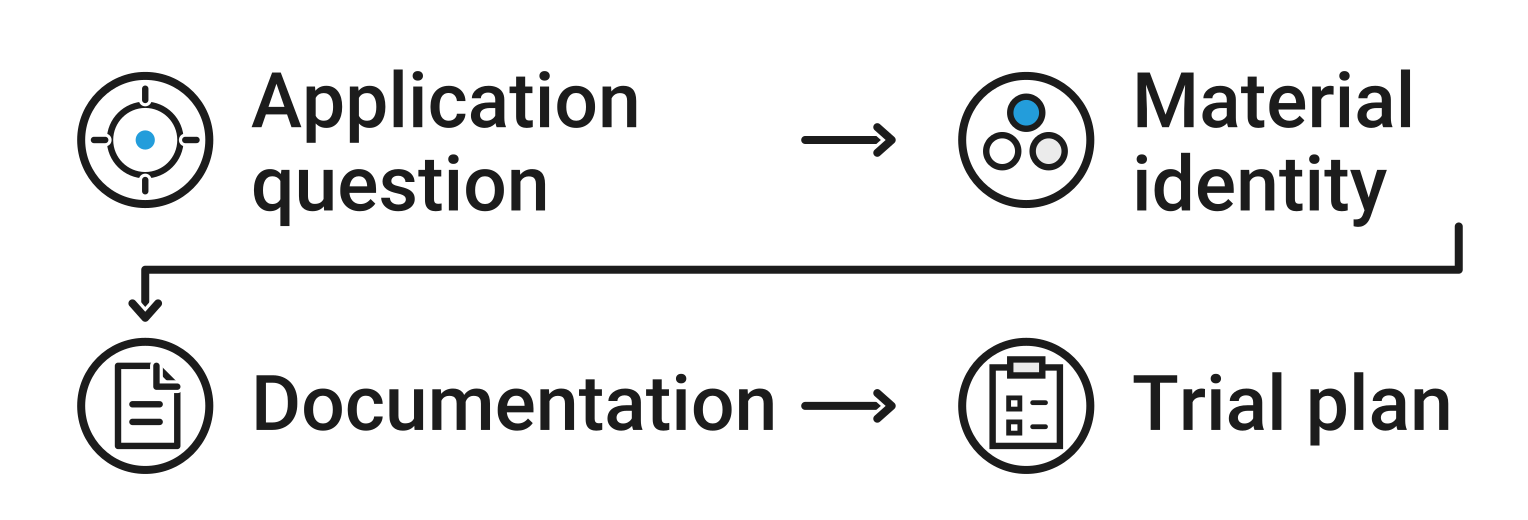
A conceptual guide to preparing your inquiry, from application question to material identity, documentation and a trial plan. This is suggested preparation, not a prescribed qualification procedure or a record of completed testing.
A First Look at the Material Families
Three filler families provide a starting point for this introductory series:
- 3M™ Glass Bubbles: hollow glass microspheres.
- 3M™ Ceramic Microspheres: solid ceramic particles, distinct from hollow microspheres.
- Kenospheres®: a separately branded family of hollow ceramic microspheres made from alumino-silicate materials.
These three selected filler families are part of our broader portfolio, which also includes 3M™ Personal Protective Equipment.
The family name establishes what is being discussed. A candidate grade and its current documentation are the next level of detail. We recommend keeping that identity visible throughout inquiries, sample evaluation and purchasing discussions, so that everyone is referring to the same material.
One Application, Four Perspectives
A shared inquiry can bring together the questions from across your team:
R&D and Formulation
Describe the intended change, the formulation type and the properties that must be retained. Separate the target from an untested expectation about what a filler will achieve.
Production
Describe the relevant equipment, addition stage and operating constraints. Identify any difference between the proposed trial and the intended production process.
Quality Control
State how the result will be judged: the measurement method, sample preparation, units, baseline and acceptance criteria. Agree on these before comparing candidate materials.
Procurement
Identify the requested product or grade, estimated quantity, destination and timing. Ask for confirmation of availability and commercial terms for that particular request.
We suggest this structure to help you organise the conversation. It is a planning guide, not a prescribed qualification procedure. One person may cover several of these responsibilities.
What to Bring to a Material Discussion
You do not need a completed development programme to make an inquiry. A concise brief can start with the following information:
- Application and stage. Name the intended product and whether you are exploring options, planning a trial, investigating a result or considering procurement.
- The main objective. State the property you want to change. Include its present value, target and units if those are available.
- The properties to preserve. List the acceptance limits that remain important, rather than treating one improved measurement as the whole decision.
- Material identity. Give the family and grade under consideration, or say that grade selection is still open. Include the document revision when discussing a published value.
- Formulation context. Describe the general system and relevant constraints. Begin with information you are authorised to share; agree how to handle confidential details before sending a proprietary recipe.
- Process context. Summarise the equipment, scale and relevant stages. Flag any planned change between the trial and production.
- Evaluation plan. Identify the comparison material, test methods, sample preparation and decision criteria. Mark unknowns explicitly.
- The next action needed. Ask for documentation, a sample, formulation support or a quotation. Include timing and quantity where relevant, while leaving supply details to be confirmed.
Keep this brief with the trial record. If the grade, process or acceptance criteria change, update the brief before interpreting the next result. That preserves a clear account of what was actually evaluated.
Choose the Request That Matches Your Next Decision
Use our four dedicated request routes to tell us what you need:
- Documentation: name the product and the technical information you need through the documentation-request route. Confirm the appropriate, current grade documents before relying on them.
- Samples: name the product of interest and describe the intended evaluation. Confirm the available sample and arrangements before planning around it.
- Formulation support: explain the application question, relevant constraints and evidence already available.
- Quotation: provide the product identity and requested quantity, with destination and timing as useful context.
Please confirm availability, document suitability, response timing and commercial terms with us for your specific inquiry.
An Example of a Useful First Inquiry
Consider a hypothetical coatings team exploring a lower-density product. This is an illustrative planning example, not a customer case or a reported trial.
The team could begin by describing its coating type, current density and measurement method, the application behaviour it needs to retain, and the equipment available for evaluation. It could then ask which product documentation is relevant and whether a candidate sample can be requested.
Before running the trial, R&D and QC would agree on the baseline and acceptance criteria, while production would identify any scale-up questions. Procurement could separately request supply information for the candidate grade. No result is assumed: the purpose of the inquiry is to define what needs to be checked.
Explore our product portfolio to identify a family of interest. If you already have an application question, request formulation support with your objective, constraints and next decision.
Explore our product portfolio
Conclusion
Our role starts with chemical materials and a conversation about your application. Bring a clear objective, the material you are considering, relevant documentation and the question you need to evaluate.
A useful first conversation does not require every answer. It requires a clear distinction between what is known, what is wanted and what still needs to be demonstrated.
You might also be interested in...


Increasing Time Until Condensation: Advanced Applications of 3M™ Glass Bubbles (Part 2)
You might also be interested in...

How can we help you?

24 Vasilissis Olgas Str. | 15124 | Athens | Greece
Phone: (+30) 213 0907763
Reg. Nr.: 181737601000
VAT. Nr.: 802731899
