Blog
Increasing Time Until Condensation: Advanced Applications of 3M™ Glass Bubbles (Part 2)
Reported July 2018 3M™ S22 laboratory test results describe an average total accumulated-drop endpoint of 45 minutes under the stated test conditions; this is not independent validation of all formulations.
Explore the July 2018 3M™ S22 reported test results, the historical laboratory starting formulation context, and formulation factors considered in condensation delay evaluation.
Moisture control remains an important consideration in architectural coatings. This Part 2 discusses the July 2018 3M™ study context and formulation factors such as thermal conductivity, dry-film density, and CPVC (Critical Pigment Volume Concentration) balance.
This second part explores condensation delay using reported laboratory data from a July 2018 3M™ technical paper and a historical laboratory formulation context.
This second part explores condensation delay using reported laboratory data from a July 2018 3M™ technical paper and historical test formulations. If you haven't read Part 1 yet, start there for the fundamentals.
Table of Contents:
Related 3M™ Glass Bubbles Articles
The Technology Behind Anti-Condensation Paints (Part 1)

How 3M™ Glass Bubbles Improve Thermal Insulation in Exterior Paints

Mastering the Metering and Mixing of 3M™ Glass Bubbles
Understanding the Science Behind Condensation Formation
Condensation occurs when surface temperatures fall below the dew point.
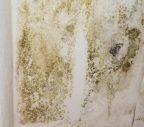
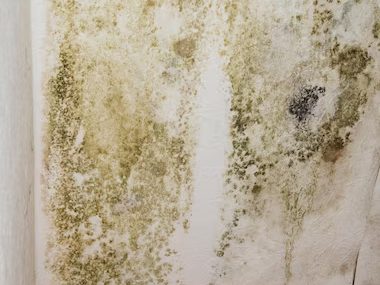
The 3M™ technical paper discusses condensation, dampness, mold, and substrate degradation as background issues; the reported test does not establish field prevention or remediation outcomes.
Thermal Conductivity and Other Factors in Anti-Condensation Performance
A coating’s thermal behavior can depend on factors including:
- Thermal conductivity (K-value)
- Dry-film density
The technical study reports:
Calculated particle conductivity values provide material-level inputs, while complete-coating thermal design factors may influence performance under defined conditions; the study endpoint was accumulated-drop timing.
K-Values of Glass Bubbles vs Standard Fillers
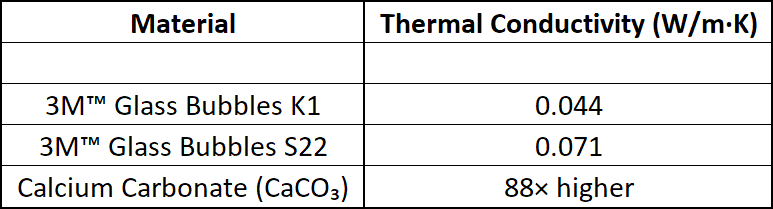
Table 1, 3M Technical Paper
Dry-Film Density: A Critical Performance Driver
The study evaluated multiple commercial anti-condensation paints vs. a standard wall/ceiling paint.
(See Table 2, 3M Technical Paper)
Key findings:
- Standard wall paint: 24 min
- Commercial anti-condensation paints: 20–44 min
- Among the five commercial samples reported, sample #5 had the longest reported mean endpoint: 44 min with a dry-film density of 0.79 g/cc.
- The reported samples show an association between dry-film density and endpoint time, but density alone does not determine condensation resistance.
The reported density and endpoint relationship was observed among the tested formulations and should not be interpreted as a density-only law.
Lower dry-film density was associated with longer condensation delay in the reported samples; other formulation factors may also influence results.
The reported results do not establish that 3M™ Glass Bubbles universally outperform traditional fillers; formulation-specific comparisons require matched evidence.
Test Method (Scientific Setup)
The condensation performance was measured using 3M’s controlled chamber method:
- High-humidity chamber set at 22°C (dew point 19–20°C)
- Cold chamber at 3°C
- Painted aluminum panels placed between the chambers
- Measured parameter: Time until the first accumulated water drop slides or falls from the panel, not the first visible appearance of condensation
The test method reports performance differentiation under the described conditions, but accuracy and repeatability were not independently established.
Historical S22 laboratory starting formulation with 3M™ Glass Bubbles
Historical laboratory starting formulation
Reported properties of the historical S22 laboratory starting formulation:
- Wet density: 0.97 g/cc
- Dry density: 0.95 g/cc
- PVC: 60%
- CPVC/PVC ratio: 1.16
- Glass Bubbles loading: 11 weight units; 5.64 wt% in wet paint, 25 vol% in wet paint and 50 vol% in the dry film
- Average total test time: 45 minutes under the defined laboratory conditions
Under the defined test conditions, the S22-containing laboratory formulation reached the endpoint at an average total time of 45 minutes compared with 24 minutes for the standard wall/ceiling reference paint. The endpoint was the first accumulated water drop sliding or falling from the panel, not the first visible appearance of condensation.
S22 Glass Bubbles in the reported laboratory formulation context
The reported 0.071 W/m·K value refers to calculated Glass Bubbles conductivity and should not be interpreted as measured thermal conductivity of the finished coating. The reported 1.16 ratio refers to CPVC/PVC comparison within the study context.
The historical formulation report associated lower dry-film density with the measured endpoint in its study context; commercial and laboratory formulations remain distinct and density alone does not determine endpoint time.
The reported below-CPVC formulation was described as nonporous in the study context; the source provides a durability design rationale, not a demonstrated scrub, water-resistance, or service-durability test result.
The historical formulation reported no CaCO₃; avoidance of thermal bridging in finished systems was not demonstrated.
The reported formulation and test results provide historical laboratory context, not a ranking of all moisture-control coating systems.
Potential application contexts requiring final-paint, substrate, and application evaluation
- High-humidity interiors requiring final system evaluation
- Bathrooms and kitchens requiring final system evaluation
- Basements and semi-underground rooms requiring final system evaluation
- Garages and storage spaces requiring final system evaluation
- Cold surfaces prone to dampness requiring final system evaluation
- Residential and commercial buildings requiring enhanced moisture control evaluation
Conclusion
3M™ Glass Bubbles are discussed as a formulation component in the reported July 2018 3M™ study; final anti-condensation coating performance depends on the complete coating system and evaluation conditions.
Under the defined test conditions, the S22-containing laboratory formulation reached the endpoint at an average total time of 45 minutes compared with 24 minutes for the standard wall/ceiling reference paint.
Interested in engineering high-performance anti-condensation coatings?
Request a sample or formulation consultation today.
Optimize your paint formulations today!
Sources
3M. The use of 3M™ Glass Bubbles to increase time until condensation forms on painted surfaces. Technical paper, issued July 2018 (14046HB; 98-0212-4284-1). (Download Source)
Relevant locators: p. 2 Table 1: calculated bubble K; p. 3: method endpoint/settings and Table 2 commercial/reference results; p. 4: Table 3 laboratory starting formulation and adjacent narrative/property blocks; p. 5: suitability and technical-information limitations. Primary historical study evidence. Table 3 alone does not locate the 24-min comparator or the 45-min measured endpoint.
3M. 3M™ Glass Bubbles: K Series, S Series, iM Series. Product information, issued November 2025, Rev. E (18693HB; 98-0212-4117-6). (Download Source)
Relevant locators: pp. 1–2: general material/composite-dependence context and calculated particle-only qualification; p. 4: issue/revision and suitability limitation. Separate selected general material reference. Not evidence for the July 2018 experiment or a finished-paint, field-performance, availability or latest-all-market claim.
You might also be interested in...
Increasing Time Until Condensation: Advanced Applications of 3M™ Glass Bubbles (Part 2)

You might also be interested in...
Increasing Time Until Condensation: Advanced Applications of 3M™ Glass Bubbles (Part 2)
How can we help you?

24 Vasilissis Olgas Str. | 15124 | Athens | Greece
Phone: (+30) 213 0907763
Reg. Nr.: 181737601000
VAT. Nr.: 802731899
