
Blog
Understanding the New EU Ecolabel for Paints and Coatings
Performance-based sustainability requirements under Commission Decision (EU) 2025/2607
Explore what has changed in the updated EU Ecolabel framework, the key criteria affecting paint and coating formulations, and why performance, material efficiency, and durability are now central to compliance.
The sustainability framework for paints and coatings is undergoing a structural update with the adoption of Commission Decision (EU) 2025/2607. The revised EU Ecolabel criteria introduce a more performance-oriented and life-cycle-aware approach, expanding beyond formulation restrictions alone.
For formulators and coatings chemists, this update affects not only how products are declared, but how they are technically designed, tested, and validated.
This article provides a technical overview of the new EU Ecolabel framework, focusing on the elements that directly impact formulation strategy and product development.
Table of Contents:
Related Technical Articles
The Technology Behind Anti-Condensation Paints (Part 1)

How 3M™ Glass Bubbles Improve Thermal Insulation in Exterior Paints
Revolutionizing Paint and Coating Industry with 3M™ Glass Bubbles
What Has Changed in the New EU Ecolabel
The new Decision replaces the previous single product group with three distinct categories:
- Decorative paints, varnishes, and related products
- Performance coatings and related products
- Water-based aerosol spray paints
This separation reflects a regulatory acknowledgement that different coating functions require different performance and sustainability metrics.
The new criteria are valid until 31 December 2032, providing a clear medium-term regulatory horizon for the coatings industry.
Core Principles Behind the Updated Criteria
The revised EU Ecolabel framework evaluates coatings based on their environmental performance across the product life cycle, with a strong emphasis on efficiency in use and verified technical performance.
Key principles include:
- Material efficiency
Mandatory spreading rate requirements and performance-linked constraints that indirectly affect pigment and filler strategy, including opacity classes and durability thresholds.
- Durability and resistance
Products must demonstrate adequate resistance to wear, moisture, weathering, and degradation through standardized performance testing, reducing the need for frequent repainting or maintenance.
- Efficiency during the use phase
While the framework does not mandate full life-cycle assessments, use-phase impacts are addressed indirectly through performance criteria such as coverage, durability, and resistance properties that influence product longevity.
- Health and environmental protection
Strict restrictions apply to hazardous substances, including SVHCs, endocrine disruptors, PFAS, phthalates, organotin compounds, and specific uses of synthetic polymer microparticles. VOC and SVOC content limits, as well as indoor air emission requirements, remain a central part of the Ecolabel.
Overall, sustainability is assessed through measurable technical outcomes rather than marketing claims or administrative declarations alone.
Performance and Efficiency Requirements at Formulation Level
Under the new EU Ecolabel, compliance requires demonstrated performance through standardized testing. Depending on product category and claims, this includes requirements such as:
- Minimum spreading rate to ensure efficient material use
- Wet scrub resistance and pigment efficiency for interior paints
- Resistance to water, alkali, and moisture
- Adhesion to relevant substrates
- Accelerated weathering resistance for outdoor products
- Abrasion, corrosion resistance, or ecotoxicity testing for performance coatings
These requirements directly influence formulation decisions related to binder selection, pigment loading, extender systems, additives, and overall formulation balance.
Products that fail prematurely, require frequent recoating, or rely on excessive material loadings are increasingly misaligned with EU Ecolabel objectives.
VOCs, Emissions, and Hazardous Substances
Contrary to earlier simplified interpretations of “low-VOC” sustainability, the updated EU Ecolabel maintains strict and differentiated limits for:
- VOC and SVOC content in ready-to-use products
- VOC emissions to indoor air for indoor decorative products
- Formaldehyde emissions and cumulative emission thresholds
In parallel, the framework introduces comprehensive substance restrictions covering SVHCs, endocrine disruptors, PFAS, phthalates, organotin compounds, heavy metals in pigments, and non-justified uses of microplastics.
Compliance therefore requires both formulation control and documented verification through testing and supplier declarations.
What This Means for Coatings Chemists
Under the new framework, EU Ecolabel compliance cannot be achieved through administrative adjustments alone.
Formulation-level decisions must support:
- Verified coverage and opacity at lower material consumption
- Mechanical and chemical durability under defined test conditions
- Resistance to water, weathering, abrasion, or corrosion where applicable
- Controlled emissions and restricted substance profiles
Sustainability is no longer assessed solely by formulation composition, but by how the coating performs over time in its intended use environment under defined performance and emission criteria.
Performance Over Declarations
A key shift in the updated EU Ecolabel is the emphasis on demonstrated performance rather than formulation claims alone.
This includes:
- How efficiently the product is used
- How long it maintains its protective or decorative function
- Whether verified performance reduces downstream environmental impact through extended service life
For formulators, sustainability is now directly linked to engineering and formulation strategy, not label-driven positioning.
Access the Full Official Documentation
This article provides a technical orientation only.
The complete legal text and detailed criteria are available in full through the Official Journal of the European Union under:
From Regulatory Framework to Formulation Strategy
Understanding the updated EU Ecolabel criteria is only the first step.
The real challenge lies in translating these requirements into practical formulation solutions that deliver compliance through measurable technical performance.
In the next article, we move from regulatory interpretation to formulation practice, examining how advanced filler technologies such as 3M™ Glass Bubbles and Ceramic Microspheres can be used to support material efficiency, durability, and use-phase performance under the EU Ecolabel (EU) 2025/2607 framework.
Conclusion
The revised EU Ecolabel framework under Commission Decision (EU) 2025/2607 strengthens the role of performance-based evaluation in sustainability assessment for paints and coatings. Durability, material efficiency, controlled emissions, and verified resistance properties are now determined by formulation design and testing, not administrative declarations.
For coatings chemists, understanding the criteria is essential. Designing products that meet them through real performance is the next and decisive step.
Formulate for Performance Under EU Ecolabel 2025/2607
You might also be interested in...
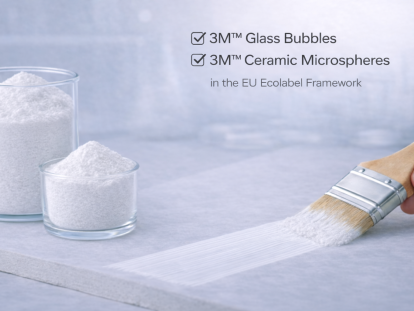
Increasing Time Until Condensation: Advanced Applications of 3M™ Glass Bubbles (Part 2)

You might also be interested in...
Increasing Time Until Condensation: Advanced Applications of 3M™ Glass Bubbles (Part 2)
How can we help you?

17 Trikalon Str. | 17342 | Athens | Greece
Phone: (+30) 213 0907763
Reg. Nr.: 181737601000
VAT. Nr.: 802731899
