
Blog
Enhancing Paints & Coatings with 3M™ Ceramic Microspheres
Discover how 3M™ Ceramic Microspheres improve paints and coatings.
3M™ Ceramic Microspheres may provide formulation-dependent opportunities such as lower viscosity, improved flow and potential burnish/scrub resistance when evaluated in suitable paint and coating systems. Finished-coating performance depends on the specific formulation, application and evaluation conditions.
3M™ Ceramic Microspheres are solid ceramic fillers described by the supplier as offering formulation opportunities in paint and coating systems. Potential benefits such as reduced resin demand, processability and durability-related properties require evaluation within the specific formulation and application context.
Table of Contents:
Related 3M™ Ceramic Microspheres Articles
Enhancing Paints & Coatings with 3M™ Ceramic Microspheres

Unlocking the Potential of Functional Fillers in Waterborne, UV-Curable Coatings
3M™ Glass Bubbles and 3M™ Ceramic Microspheres in the EU Ecolabel Framework
Introduction to 3M™ Ceramic Microspheres
3M™ Ceramic Microspheres are designed for paint and coating formulations. Their shape and particle size distribution may provide opportunities for lower resin demand, reduced viscosity and higher filler loading, depending on the complete formulation. Suitability for specific applications and environmental conditions requires evaluation of the finished system.
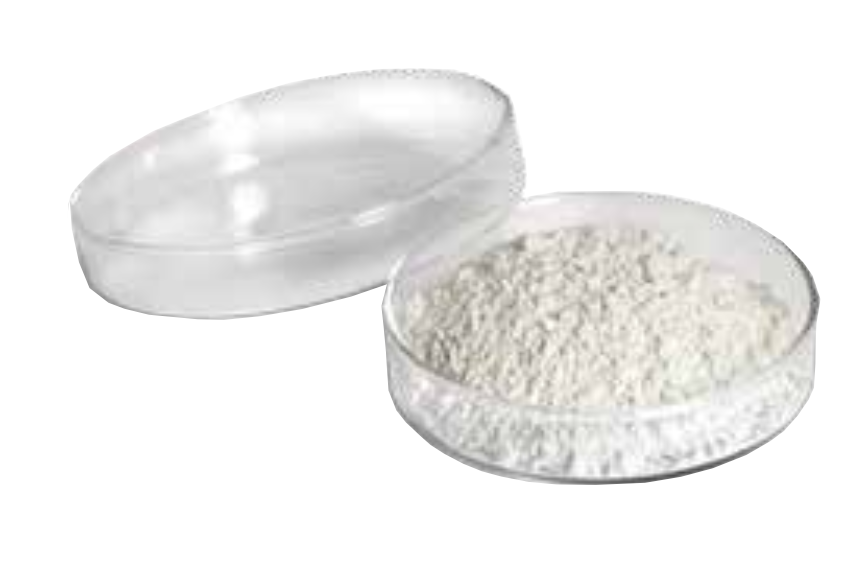
3M™ Ceramic Microspheres
Key Advantages
1. Lower Viscosity and Improved Flow (formulation-dependent)
The shape and particle characteristics of 3M™ Ceramic Microspheres may contribute to formulation-dependent flow and viscosity effects in paint formulations. The resulting behaviour depends on the specific formulation and processing conditions.
2. Reduced Resin Demand (formulation-dependent)
The particle characteristics and size distribution of 3M™ Ceramic Microspheres may support resin demand and loading evaluations in suitable formulations. Actual packing behaviour and resulting formulation performance depend on the complete coating system.
3. VOC Management
Higher solids and lower resin demand may provide formulators with a potential route to address low-VOC formulation objectives. Final VOC compliance depends on the complete formulation, application and applicable regulatory evaluation.
4. Potential Burnish and Scrub Resistance Benefits
The hardness and particle characteristics of 3M™ Ceramic Microspheres are described by the supplier as supporting potential burnish and scrub resistance benefits in suitable coating formulations. Appearance retention and repainting needs depend on the specific coating system and service conditions.
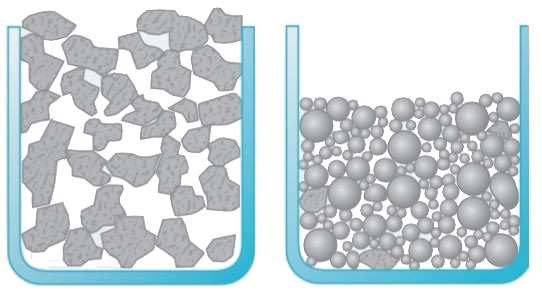
Comparison of particle packing efficiency with and without 3M™ Ceramic Microspheres.
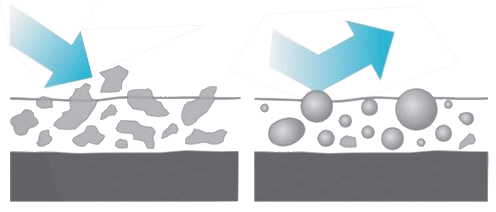
Potential low-permeation barrier and exterior durability benefits in evaluated coating formulations.
5. Potential Gloss Control Enhancement
In many applications, incorporating higher levels of 3M™ Ceramic Microspheres may help lower gloss levels without significant viscosity increase. The balance of gloss and other properties requires evaluation for the complete formulation.
6. Potential Exterior Durability Benefits
Supplier guidance describes potential low-permeation barrier and exterior durability-related benefits for suitable formulations. Finished-coating durability and weathering performance depend on the complete system and evaluation conditions.
7. UV Curing Capability
3M Ceramic Microspheres White Grades technical information states UV transparency down to 250 nm for the stated material scope. The actual relevance of this property depends on the UV system, formulation and application conditions.
8. Simplified Mixing Process
With high compression strength, 3M™ Ceramic Microspheres can be added during the standard grind process. For optimal dispersion, sand, ball, and roll mills are recommended.
9. Safety and Handling
Safety evaluation should always follow the current SDS, label information and applicable regulatory requirements. A statement regarding crystalline silica detection in a specific technical document should not be interpreted as a universal safety conclusion for every formulation or application.
Conclusion
Integrating 3M™ Ceramic Microspheres into paint and coating formulations may provide opportunities related to resin demand, VOC formulation approaches, durability-related properties and processability. These opportunities are formulation- and application-dependent and require evaluation of the complete coating system.
Interested in optimizing your paint and coating formulations? Request a sample today and take the first step towards creating high-performance, durable, and environmentally friendly coatings with 3M™ Ceramic Microspheres!
Optimize your paint formulations today!
Sources
3M Ceramic Microspheres: The shape of things to come. April 2024. Issued 4/24; HB12091; 98-0212-4263-5 Rev. B. (Download source)
Relevant locators: PDF pp. 3–4 (shape, resin demand, viscosity control and loading); PDF p. 4 (Manage VOC levels); PDF p. 5 (burnish/scrub resistance, gloss control and exterior durability); PDF p. 8 (evaluation, warranty and technical-information limitations).
3M Ceramic Microspheres White Grades product information. April 2024. Issued 4/24; 12503HB; 98-0212-4187-6 Rev. C. (Download source)
Relevant locators: PDF p. 1 (UV transmission to 250 nm; grind-stage dispersion guidance; Product Safety and Handling); PDF p. 2 (application-evaluation and revision information).
You might also be interested in...

Increasing Time Until Condensation: Advanced Applications of 3M™ Glass Bubbles (Part 2)

You might also be interested in...

Increasing Time Until Condensation: Advanced Applications of 3M™ Glass Bubbles (Part 2)
How can we help you?

24 Vasilissis Olgas Str. | 15124 | Athens | Greece
Phone: (+30) 213 0907763
Reg. Nr.: 181737601000
VAT. Nr.: 802731899
